
- All case studies
- AAA Consortium (Pty) Ltd
- Energy & Power Generation
Case Study · Hazmat & Spill Response
A hazmat trailer for a power station spill team
Twin-axle, all-aluminium, five lockable roller shutters and its own battery. Built in five weeks in Roodepoort and delivered to an Eskom Generation site on 13 August 2026.
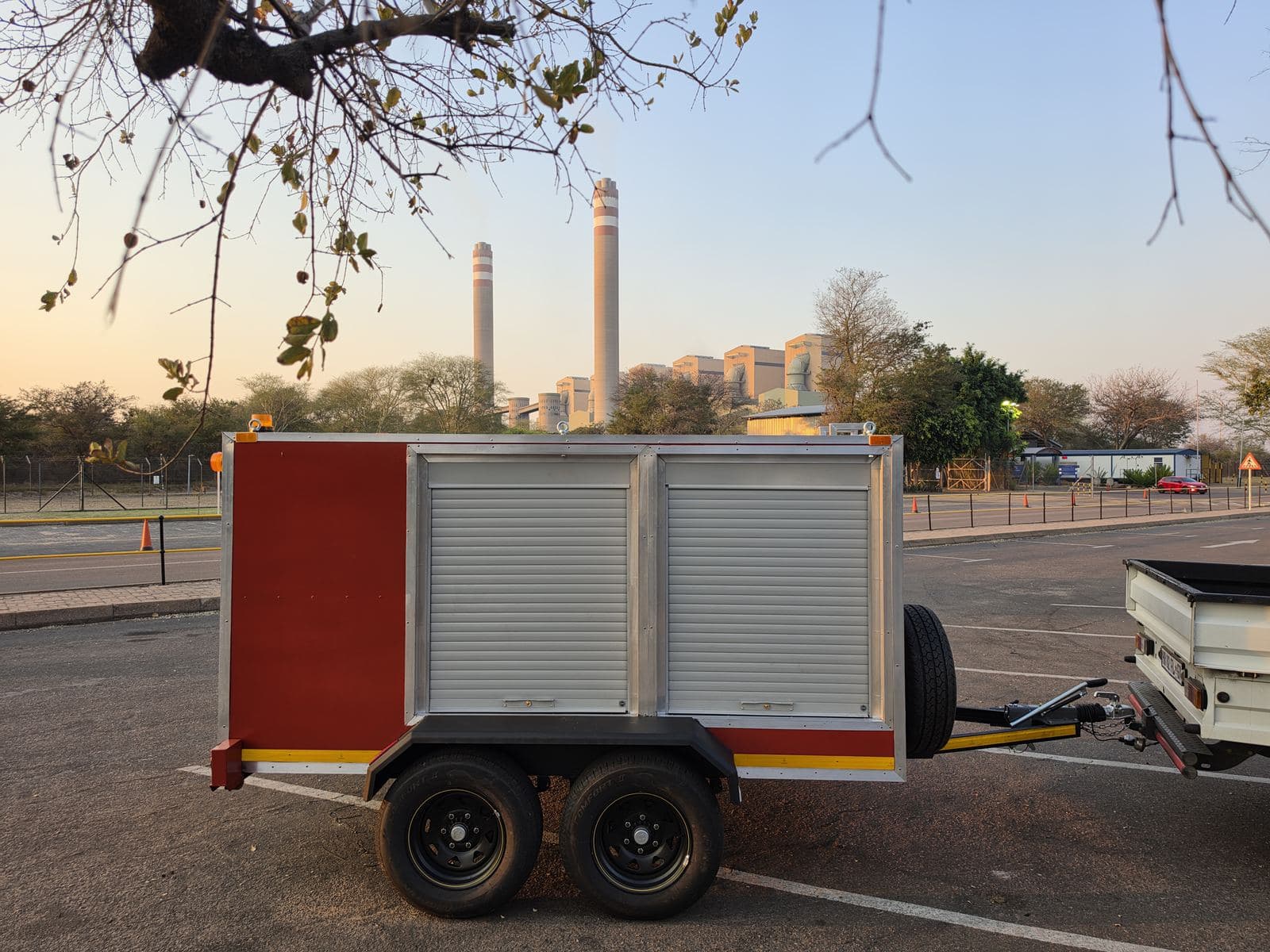 Handed over on site, August 2026
01 The brief
One trailer that carries the whole spill kit
AAA Consortium (Pty) Ltd approached us in February 2026 with a written technical specification and a delivery date. The trailer was for an Eskom Generation spill-response team. It had to carry chemical suits, absorbents and spill kits to an incident, keep them dry and locked, and still work at night with the tow vehicle switched off and unhooked.
The specification left little room to improvise. Under 2.0 m high from the ground. Roughly 3.0 m long including the drawbar. 2.4 m wide. Twin braked axles. Five lockable roller-shutter doors. An all-aluminium body on a channel-iron chassis. RAL 3000 red.
We quoted against that document, agreed the drawings and built the unit at our own workshop in Roodepoort, Gauteng. Five weeks from cutting steel to the trailer standing outside loaded.
- Client: AAA Consortium (Pty) Ltd
- End user: Eskom Generation
- Sector: Energy and power generation
- Delivered 13 August 2026
02 The build
Channel iron, folded aluminium, five shutters
Chassis first, body second, paint before hardware.
The chassis is 76 × 38 channel iron, cut and jigged, welded up and epoxy-primed before anything sat on top of it. The body is 4.5 mm folded aluminium, dual-welded, a fully enclosed box rather than a panelled frame.
Five roller-shutter doors, two a side and one at the rear, each with its own lock. The roof is aluminium tread plate with three eyelets down either side for strapping kit up top, and a stainless ladder at the front with grab handles to reach it.
Paint went on in the right order. Body panels were sprayed with no hardware fitted, and the doors were sprayed separately so the jambs and door edges got proper coverage. Etch and filler primer first, then two coats of lead-free two-part acrylic urethane in RAL 3000, using the AkzoNobel system called for in the spec.
Every hole drilled into the aluminium afterwards, for lights, handles, steps and the ladder, got a corrosion-inhibiting pre-treatment before the fastener went in. The fasteners were treated too.
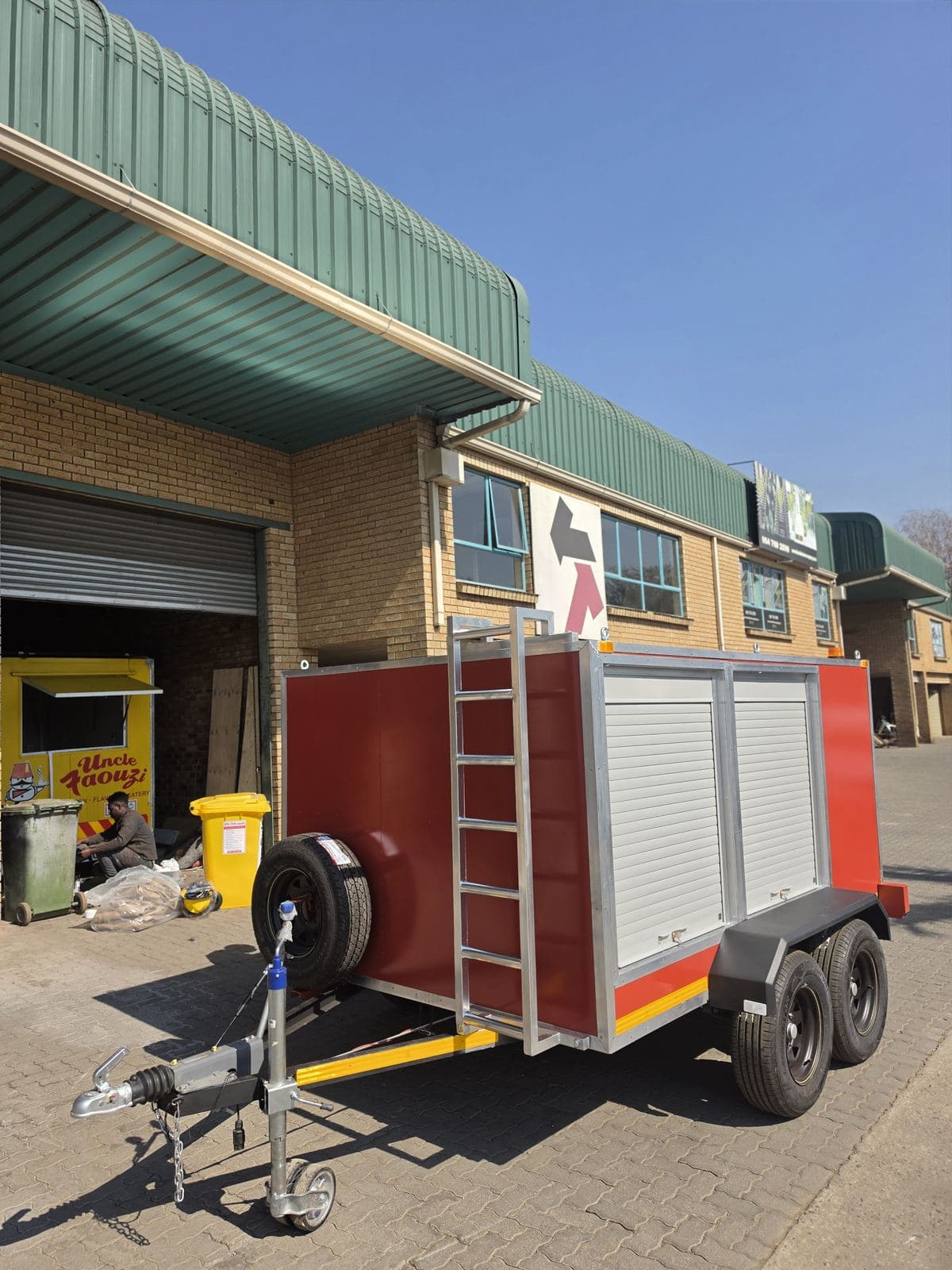 Workshop, Roodepoort · Ladder, shutters and side stripe on, ready for final fitting.
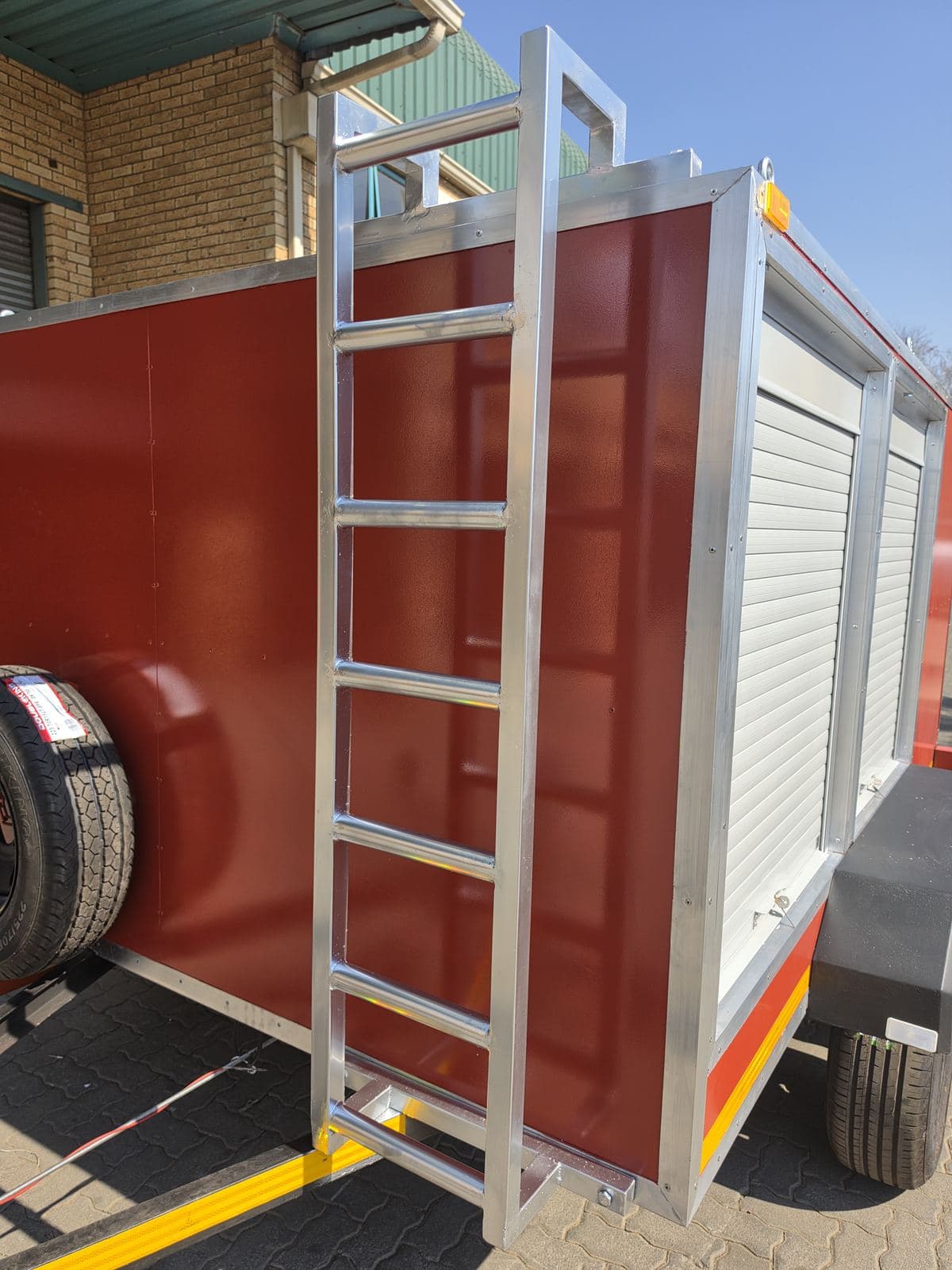 Roof access · Front-mounted ladder and grab handles for the tread-plate roof.
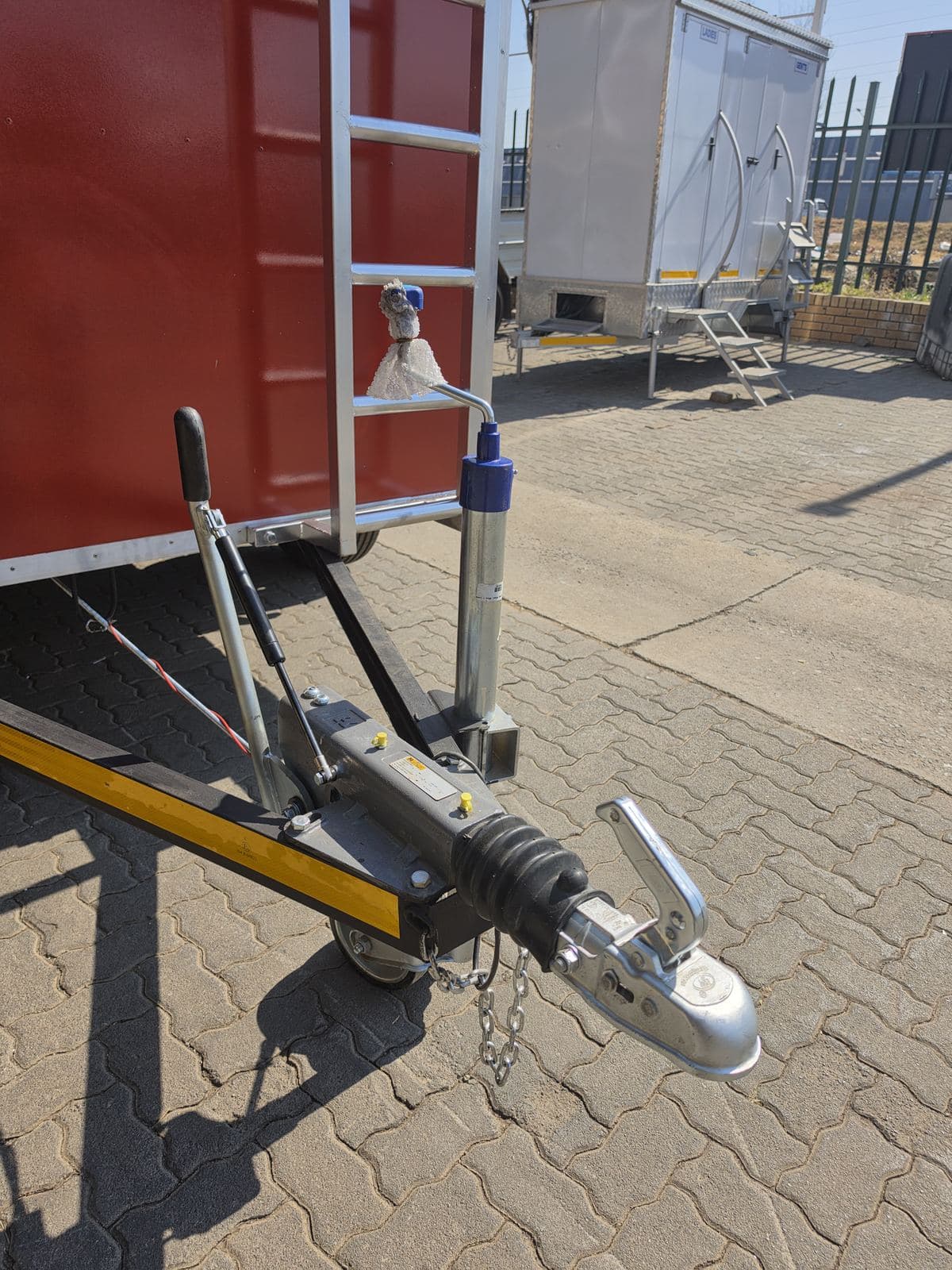 Drawbar · 50 mm ball coupler, breakaway line, safety chain, double jockey wheel.
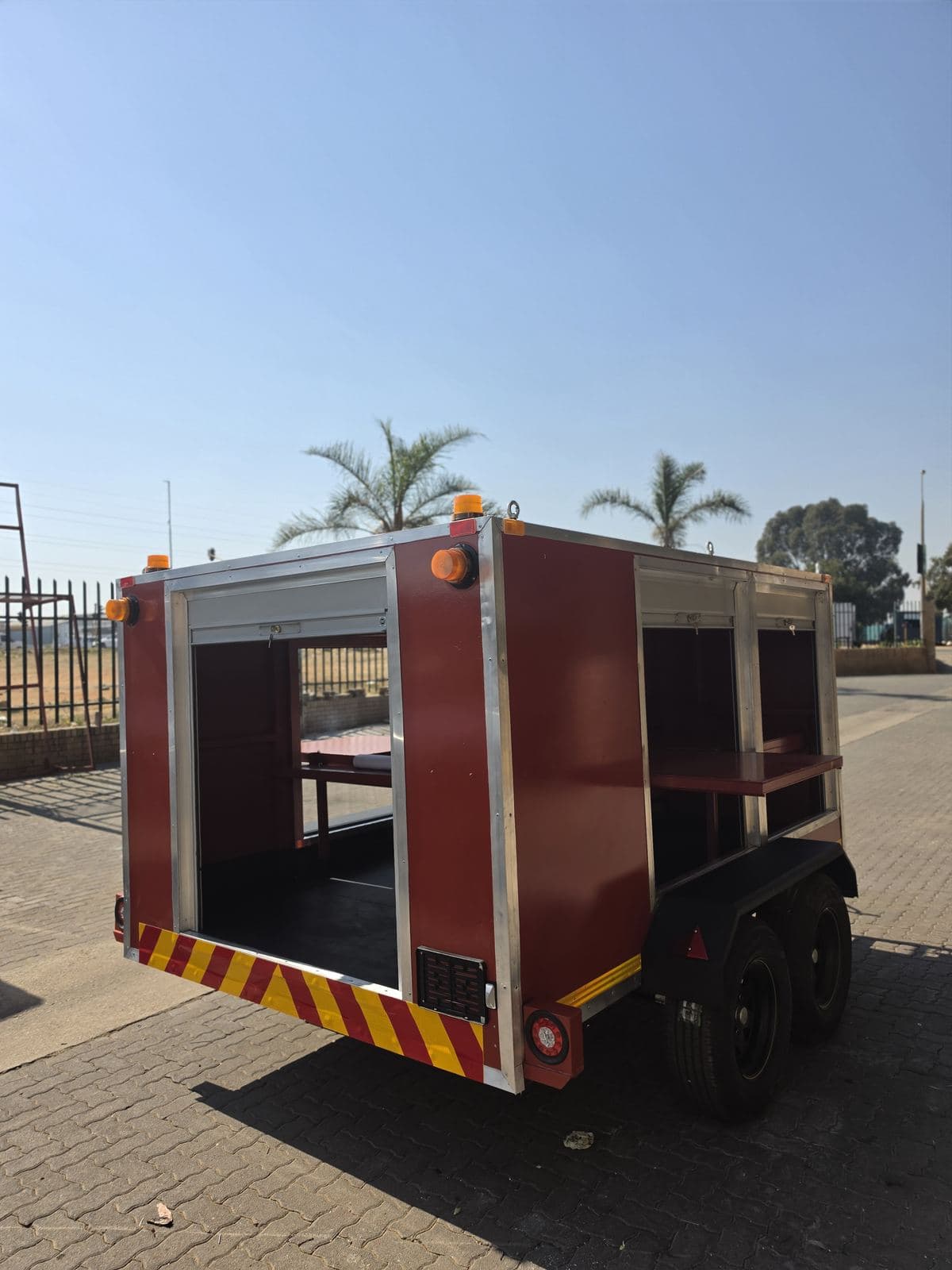 Rear chevron · Chevron board at the rear, reflective trim along the body line.
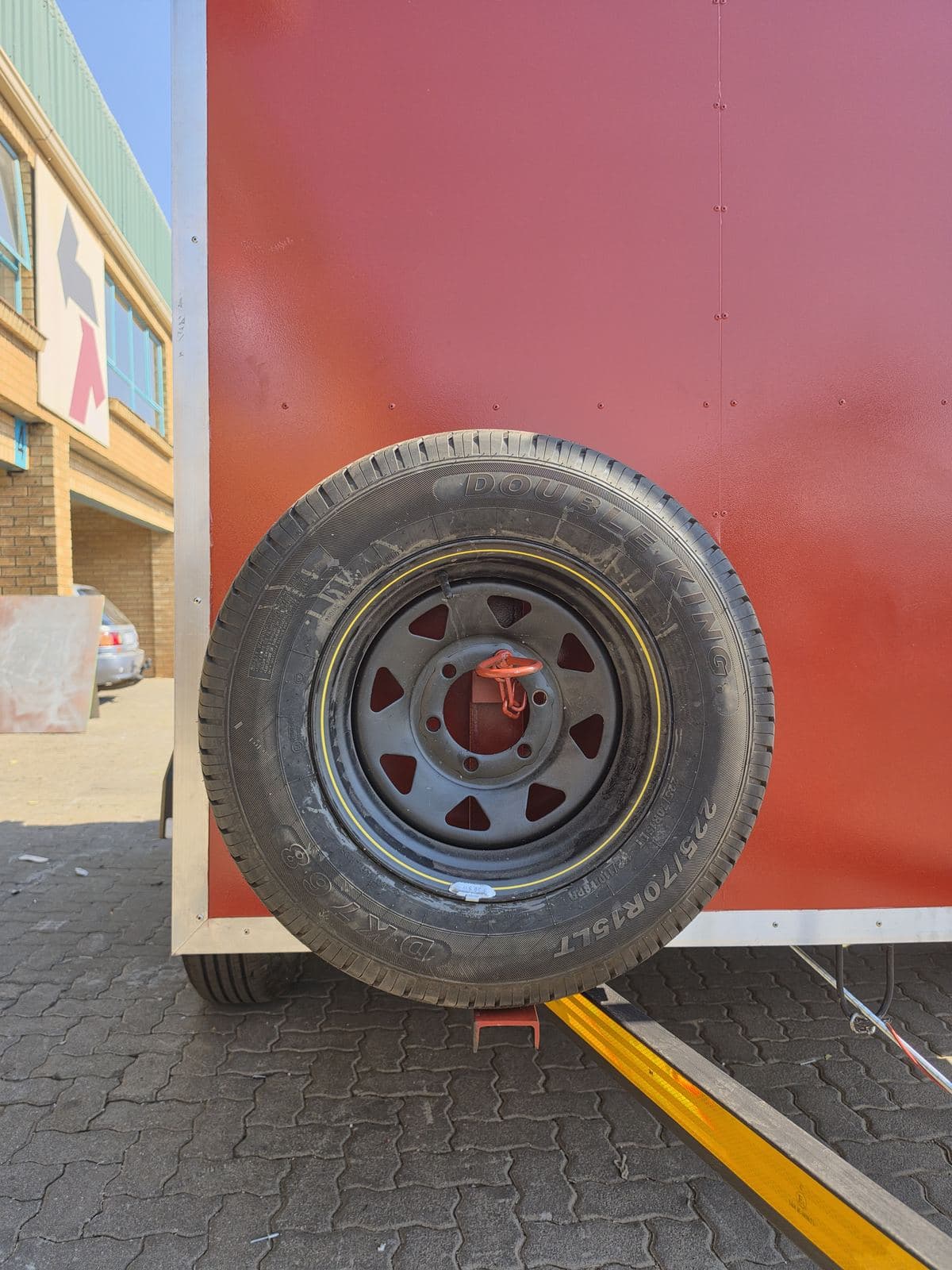 Spare wheel · Lockable spare on a fail-safe mount, same size as the road wheels.
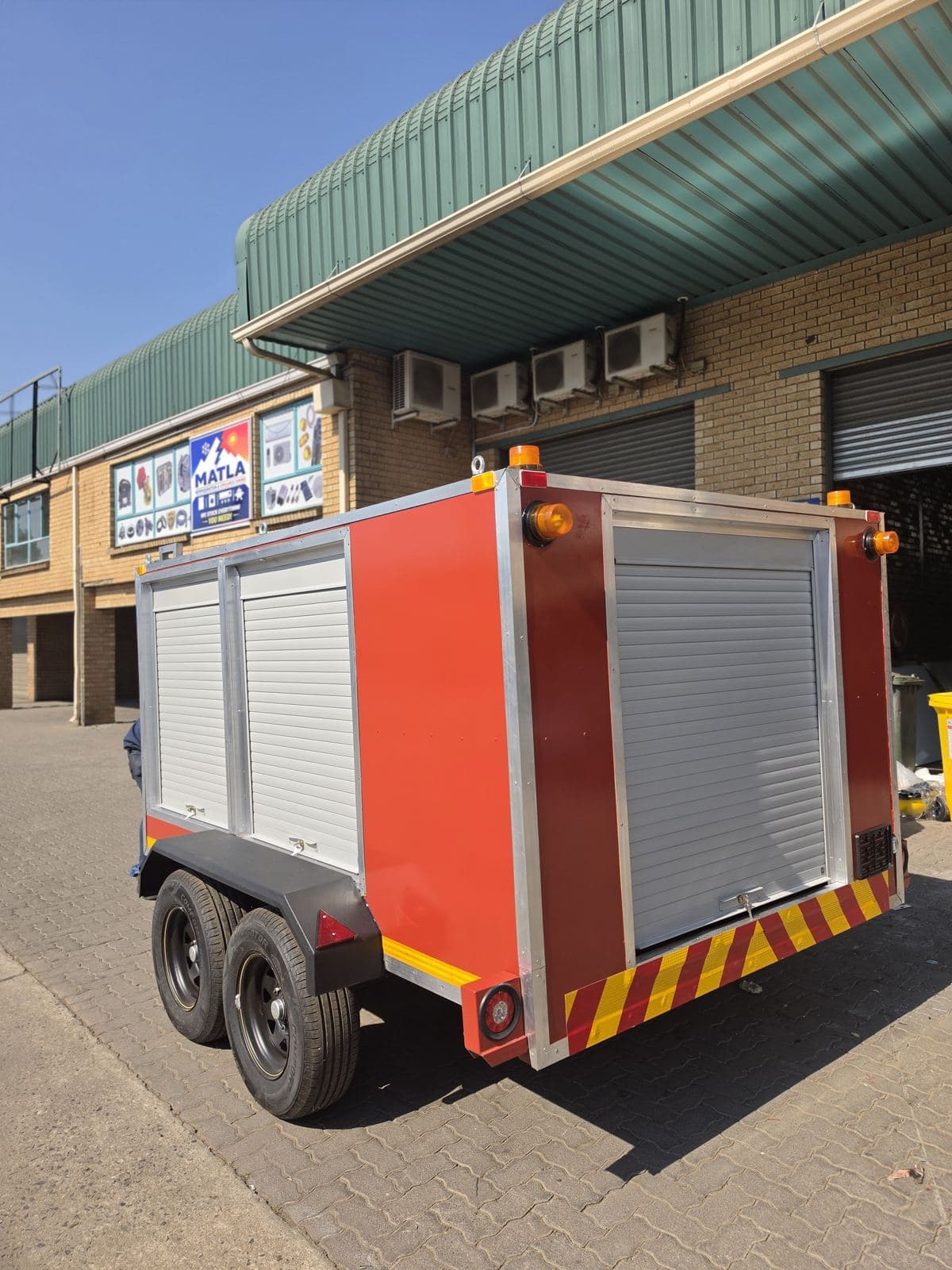 Finished unit · Rear quarter, shutters down, beacons and flashers fitted.
03 Details
Running gear, finish, lighting
Twin braked axles
Two run-in braked axles rated 1,800 kg each. A 50 mm ball coupler with an auto breakaway brake line and safety chain. All-terrain 15-inch light-truck tyres, with a lockable spare on a fail-safe mount. A heavy-duty double jockey wheel bolted to the drawbar. Tyre pressures marked above each wheel arch.
RAL 3000 over etch primer
Corrosion pre-treatment, filler primer, then two coats of two-part acrylic urethane. A 100 mm red stripe across the front and down both sides, yellow reflective trim to the road ordinance, and a chevron board at the rear. Shelving is coated in chip-resistant paint.
Works with the bakkie unhooked
A 105 Ah deep-cycle battery with a CTEK intelligent charger, fed either from the tow vehicle or from a 220 V wall socket on a 10 m shore line. LED string lights in every compartment. Two roof beacons at the rear and four LED flashers, all running off the trailer battery and independent of the tow vehicle.
Wiring runs in a loom, clipped to body members, with rubber grommets wherever it passes through a panel.
04 Inside
A floor that drains and shelves that move
The floor is aluminium, rubberised, with a drain hole in each compartment. If a drum lets go inside, the compartment can be hosed out instead of soaking.
Each compartment has one adjustable shelf in 4.5 mm smooth aluminium plate, painted with a chip-resistant coating. Three compartments carry slide-out trays rated at 50 kg each, for the heavier items the team does not want to climb in after.
Compartments are lit by LED string lights so the shelves are readable at two in the morning without a torch in your teeth.
Spill kits, chemical suits and consumables were supplied with the unit, but the trailer is the part we built.
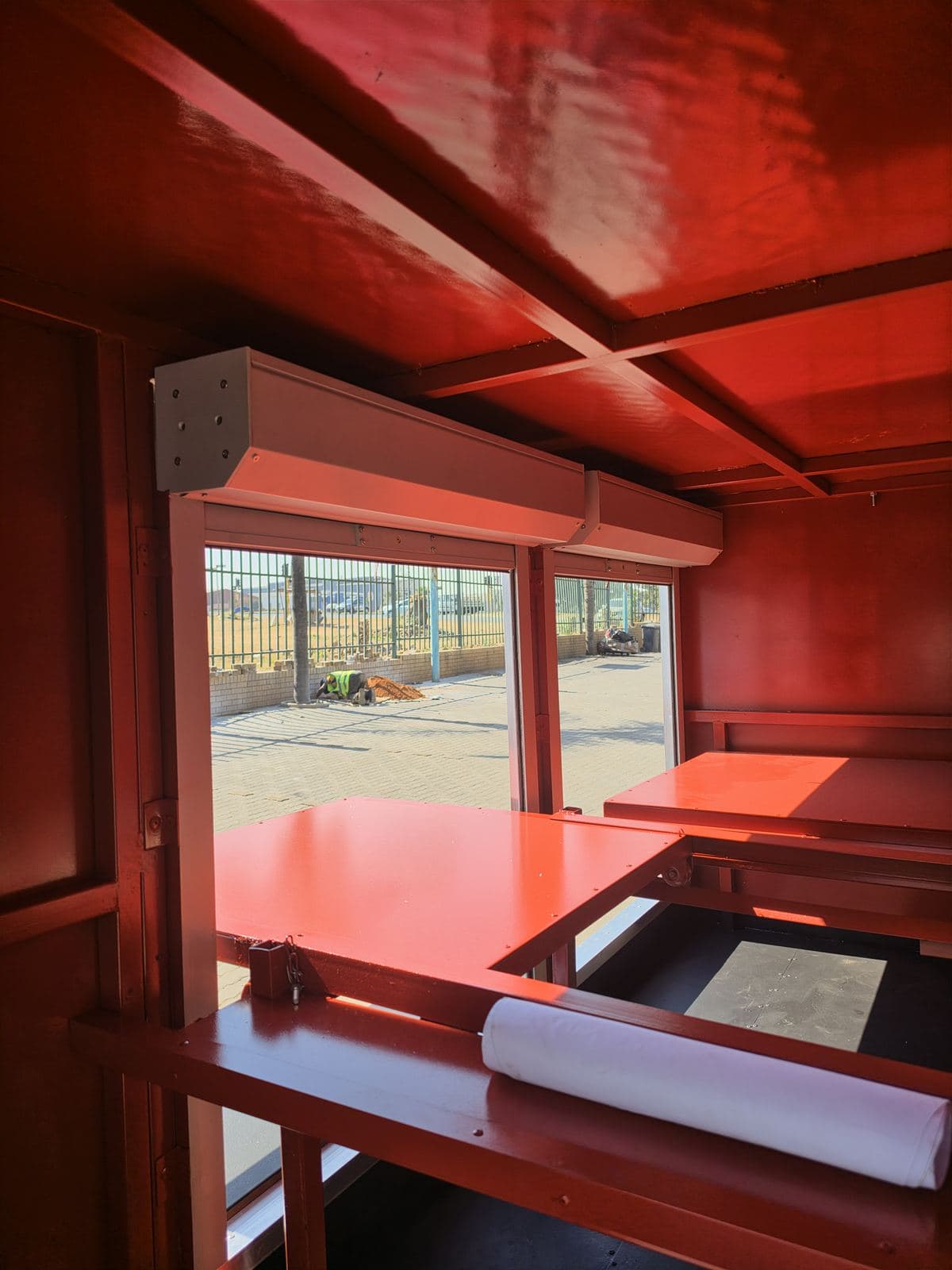 Adjustable shelf · One adjustable shelf per compartment, aluminium plate.
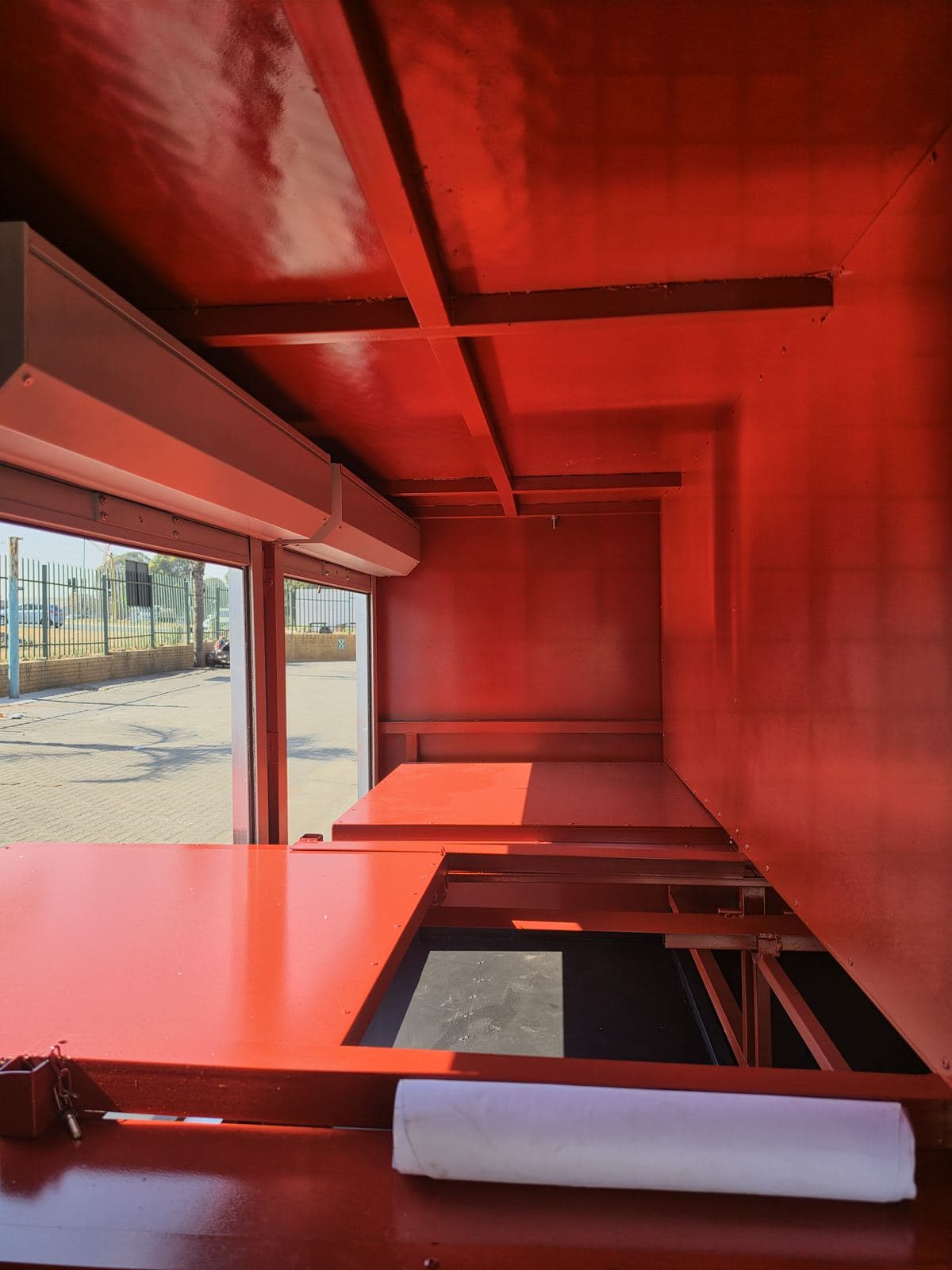 Slide-out tray · Three trays, 50 kg each, for the heavier kit.
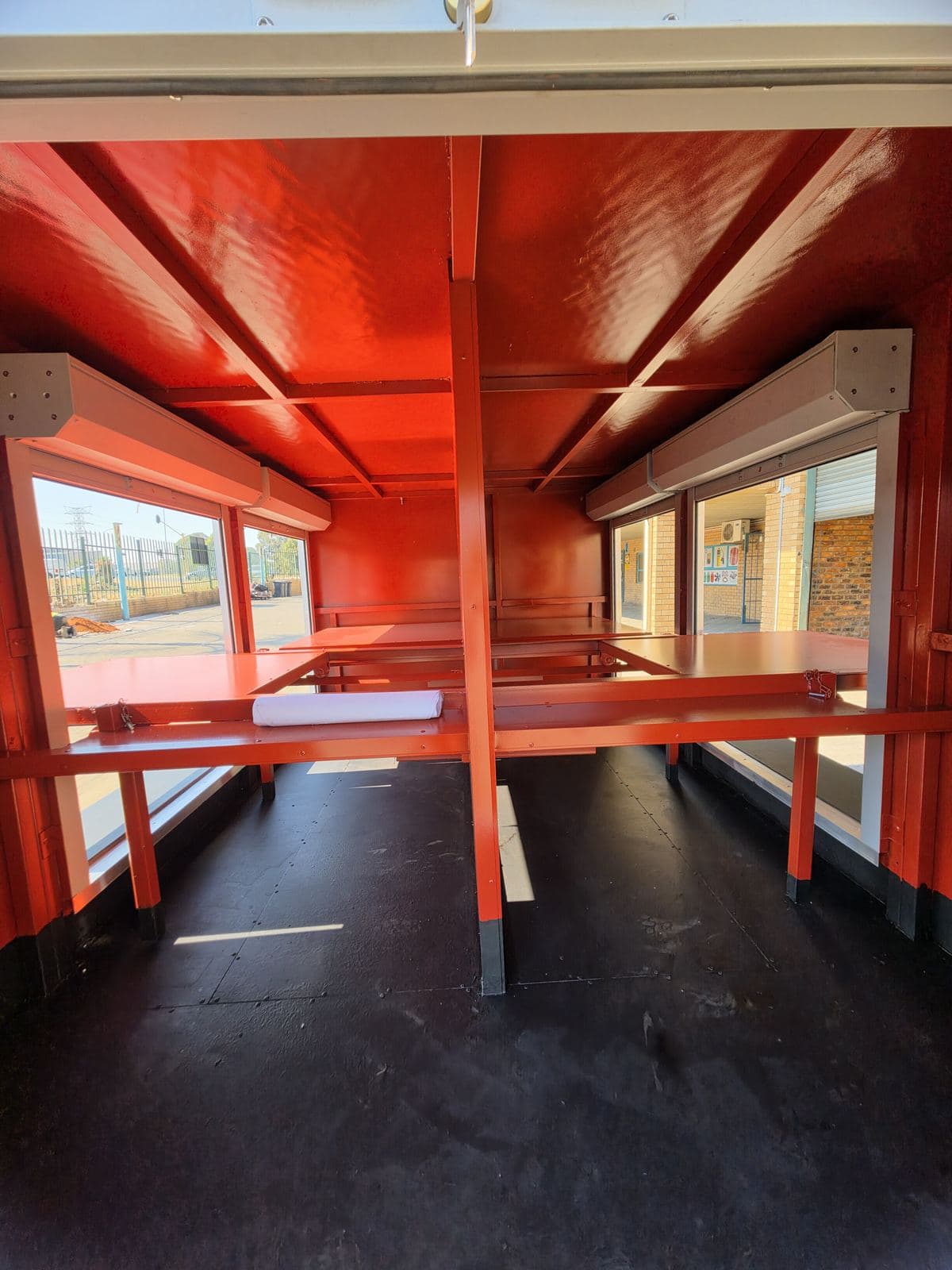 Rubberised floor · Rubberised aluminium floor, drain hole in every compartment.
05 Outcome
Inspected, accepted, loaded
The trailer was inspected and accepted on an Eskom Generation site and handed over on 13 August 2026, about five weeks after the first cut and six months after the first conversation.
It went out under the yard lights with the kit loaded and the beacons wired to its own battery. Nothing on the unit depends on the vehicle towing it.
“The trailer and equipment were delivered to specification and we were satisfied with the quality of the work and the professionalism of the supplier. We would not hesitate to use Trailored again.”
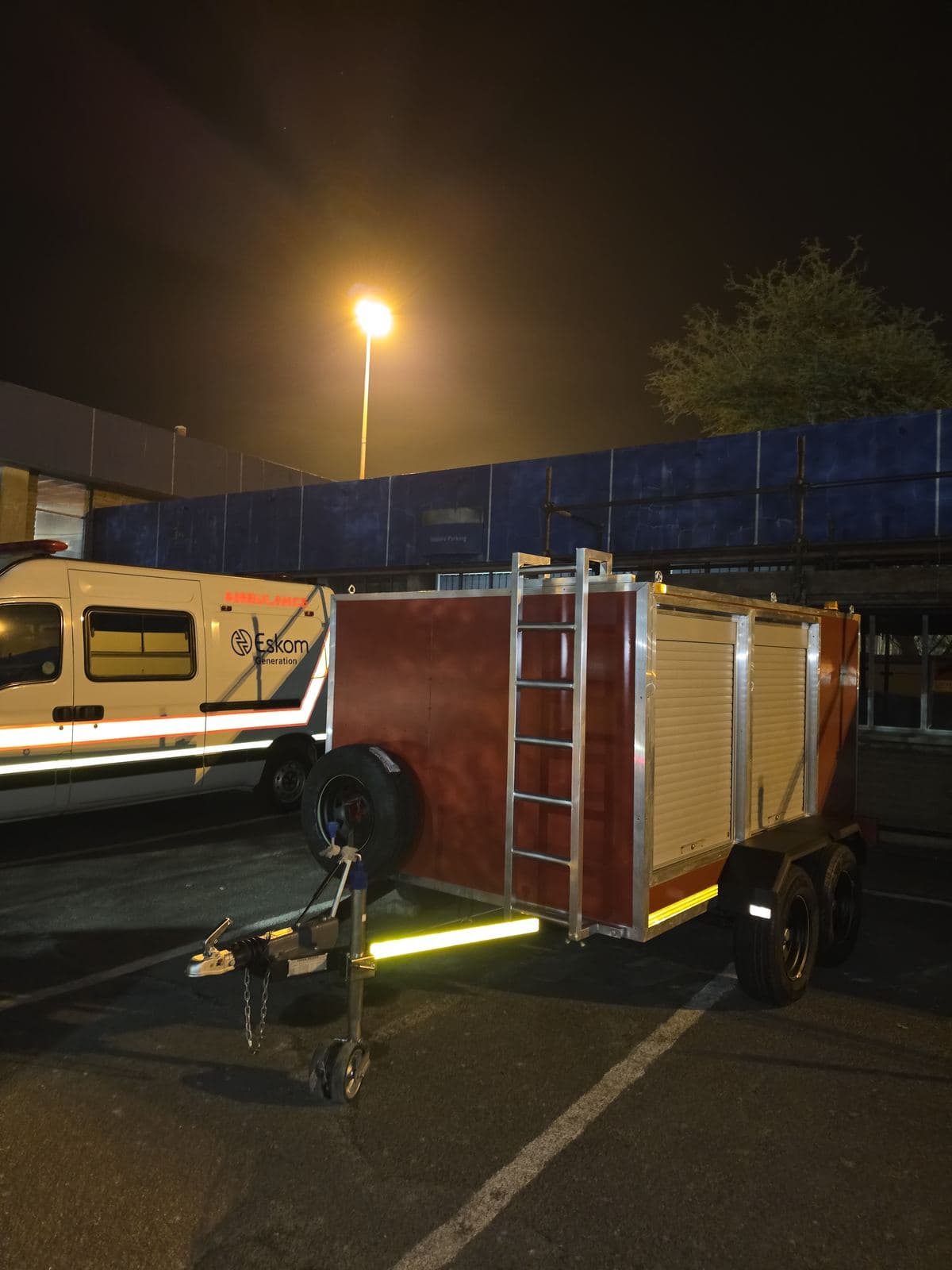 Night handover
06 Questions
Questions about the hazmat trailer build
Can you build to our own written specification?
Yes. This unit was built line by line off the client's spec document, from the axle rating and door count down to the paint system and the height of the tyre-pressure lettering. Send us the spec and we will quote against it and mark up anything we would do differently before you sign the drawings.
How long does a trailer like this take?
This one took five weeks in the workshop. For a similar hazmat unit, plan on five to six weeks from approved drawings, plus whatever time the drawing and approval stage takes on your side.
Does the emergency lighting still work if the trailer is unhooked?
Yes. The beacons, flashers and compartment lights run off a 105 Ah deep-cycle battery on the trailer, not off the tow vehicle. The battery recharges from the vehicle while driving, or from a 220 V socket through the CTEK charger and the 10 m shore line.
Can it be built in a different colour or layout?
Yes. Colour, branding, the number and position of doors, shelving and tray layout, lighting and battery size are all specified per build. The body, chassis and running gear stay the same platform.
Need something like this? Send the specification and we quote against it.
— More projects
Other work on record.
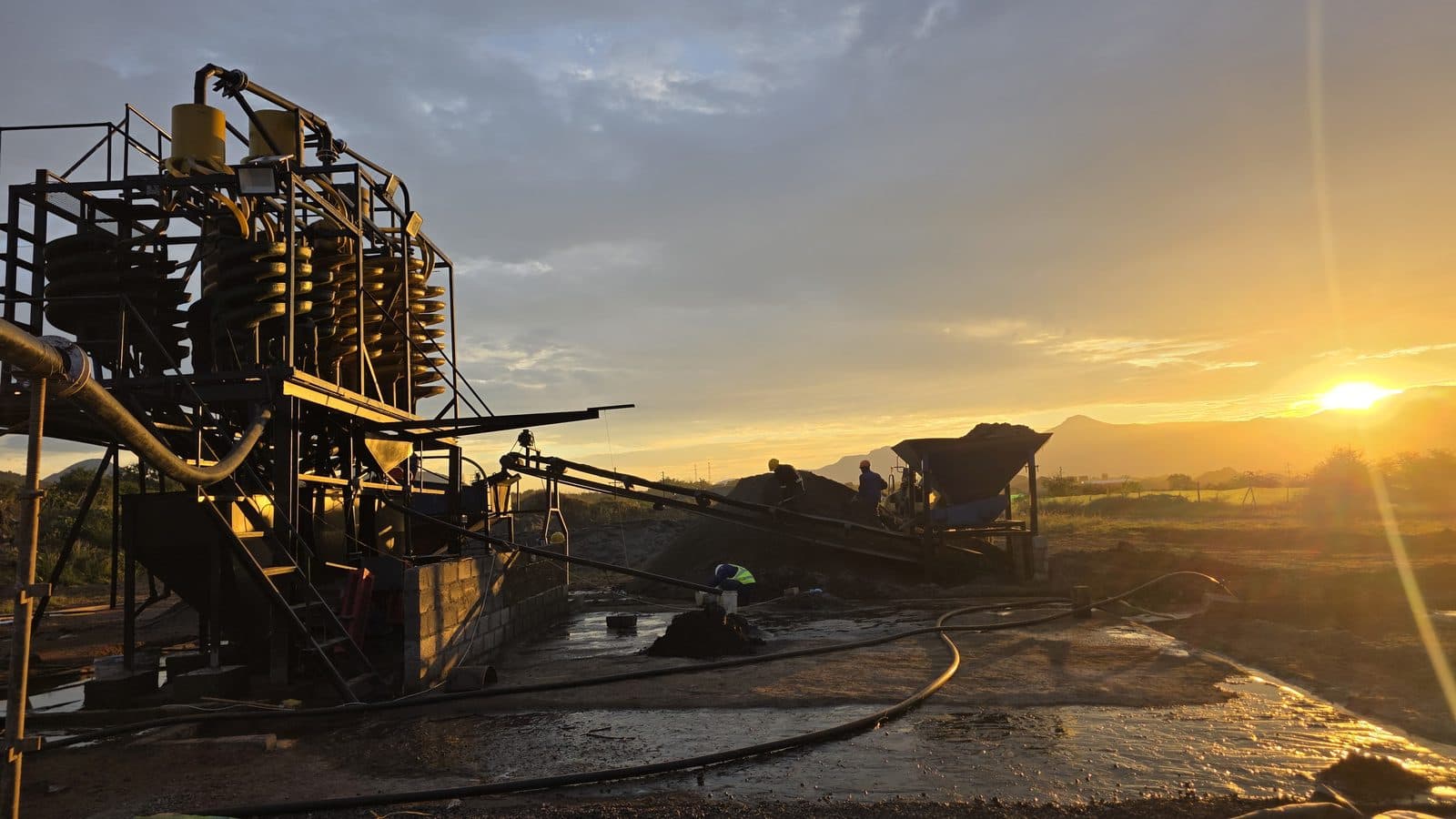 Mineral Processing
A Chrome Beneficiation Washplant, Fabricated and Commissioned
Trailored built the steel for Flow Minerals' chrome washplant from drawing to start-up: feed bins, wash bins, slurry distributor heads and an eight-metre spiral support structure, erected and commissioned on site.
Read case study Film & Media Production
From 34-Ton Tautliner to Mobile Film Studio
Trailored stripped a 34-ton curtain-side tautliner back to its chassis and rebuilt it as a self-contained mobile film studio — private dressing rooms, an en-suite bathroom with full plumbing, and on-board power, all road-legal on the original tri-axle.
Read case study07 Need one like this?
We build hazmat and spill-response trailers to order
We build hazmat and spill-response trailers to order for power stations, mines, chemical plants, municipalities and fire and rescue services. Tell us what has to go in it.